Mostrar mensagens com a etiqueta Outros Livros de artista || Other's Artist's books. Mostrar todas as mensagens

A partir de 14 de Maio - Exposição de Poesia Visual, 40 anos da revista Artéria, na Caixa Cultural, São Paulo!


CAIXA Cultural São Paulo exibe poesia visual em mostra dos 40 anos da revista Artéria. 14maio a 17jul2016


image


Exposição em São Paulo reúne mais de 60 obras de importantes artistas que já passaram pela publicação independente de poesia experimental Artéria desde os anos 1970. Em cartaz de 14 de maio a 17 de julho de 2016. Entrada gratuita
CAIXA Cultural São Paulo inaugura, no dia 14 de maio de 2016, sábado, às 11 horas, a coletiva “Artéria 40 anos”, que reúne mais de 60 obras, entre serigrafias, adesivos, objetos, vídeos, áudios e plataforma digital interativa, além das 10 edições originais da revista Artéria. A curadoria é dos poetas, editores e colecionadores Omar Khouri e Paulo Miranda, que encabeçaram a publicação em suas quatro décadas de existência.
A exposição traz importante produção da chamada poesia intersemiótica (mais conhecida como poesia visual), com trabalhos publicados deJulio PlazaAugusto de CamposDécio PignatariRegina SilveiraTadeu JungleArnaldo Antunes e Lenora de Barros, entre outros.
“Além de trazermos os poemas, alguns verdadeiros clássicos da poesia intersemiótica, a exposição exibe originais, protótipos, objetos e primeiras edições da revista. Também estamos adaptando e retrabalhando algumas obras como a do Julio Plaza, que foi ampliada e agora ganha um novo formato especialmente para a mostra”, adianta Paulo Miranda.
“Artéria” é uma publicação independente de poesia experimental, que teve seu primeiro número lançado em 1975. Ainda em atividade, e com dez edições já publicadas, a revista sempre adotou o formato de antologia, trazendo poemas de diversos criadores, semprepreocupados com as visualidades de suas obras e as técnicas que as possibilitam, transitando entre variados códigos e linguagens.
Por isso, a exposição, semelhante às revistas, explora diversos formatos e suportes. Um dos principais destaques é a plataforma interativa, trazendo a totalidade das revistas publicadas, além poemas programados para serem manipulados pelo público por meio de uma tela sensível ao toque (touch screen).
“Artéria 40 anos” esteve em cartaz de outubro a dezembro de 2015 na Caixa Cultural Rio de Janeiro. Para a temporada em São Paulo estão programados uma oficina de poesia visual com o artista Gastão Debreix e o lançamento da Artéria nº 11, inédita.
Serviço:
Exposição: “Artéria 40 anos”
Abertura: sábado, dia 14 de maio, às 11 horas
Período expositivo: de 15 de maio a 17 de julho de 2016

Local: CAIXA Cultural São Paulo (Praça da Sé, 111 – Centro – Metrô Sé)
Informações: (11) 3321-4400
Horário de funcionamento: terça a domingo, das 9 às 19h
Entrada franca
Acesso para pessoas com deficiência
Produção: Espaço Líquido Audiovisual e EditoraPatrocínio: Caixa Econômica Federal
in http://adelantesp.tumblr.com/post/141554485151/caixa-cultural-s%C3%A3o-paulo-exibe-poesia-visual-em 

Livros de artista online

um site de pesquisa fundamental!

http://www.artistsbooksonline.org/

Site Mission

Artists' Books Online is designed to promote critical engagement with artists books and to provide access to a digital repository of metadata, scans, and commentary. The project serves several different communities: artists, scholars and critics, librarians and curators, and interested readers. ABsOnline operates as an online collection with curatorial guidelines established by an advisory board of professionals. Founded in 2004 ABsOnline is an ongoing project hosted at the University of Virginia under the direction of Johanna Drucker and with assistance from staff and interns working with the University Library and its units in digital scholarship. Anyone interested in participating in the project should contact us directly for guidelines on submissions.


Site Basics: The Conceptual Framework of Artists' Books Online

ABsOnline consists of files that display artists' books, exhibits, essays, and links to other collections or resource materials for this field. There is an index of agents (authors, publishers, binders, printers etc. of books and works represented), titles (of works, books, and sometimes objects), contributors (authors of essays, exhibits, commentary), and of collections and other resources. The indices are currently under development.
The core of ABsOnline is the presentation of artists' books in digital format. Books are represented by descriptive information, or metadata, that follows a three-level structure taken from the field of bibliographical studies: work, edition, and object. An additional level, images, provides for display of the work from cover to cover in a complete series of page images (when available), or representative images.
A basic understanding of the way the categories work, edition, and object are understood will be helpful for anyone using this collection, either as a contributor or a reader. The three levels operate according to a hierarchy, and each lower level "inherits" the properties of the category above (an object has all the characteristics of the edition of which it is a part, for instance).
Work: The highest category in the hierarchy should be understood as the overall idea or concept for the project as a whole. An example might be Pattie Belle Hasting's Scarlet Genome, which is conceived as a work with performances, a book, other documentation, and component parts. A "work" cannot be copyrighted, only elements within it that are actually produced are subject to copyright protection. The category of work is used to organize all the many component parts of a project, but anything related to actual production should go either at the edition level, or (in certain cases) with the object.
Edition: This includes all production information and materials for an edition, including but not necessarily limited to the actual texts, images, layouts and dummies, manuscripts, correspondence about production or reception, edition size, physical characteristics, design, and so on. A work may have several editions, and an edition will contain one or more objects.
Object: At this level a specific object, or instance, is being described. In cataloguing or description, this is the example one has in one's hands, and it will likely have some individuating characteristics: an inscription, a number, damage, repairs, anomalies from the printing process, an individual or unique binding, a provenance, an owner, and so on.
Images: These are page images from front to back, including spine, foredge, covers, end sheets, blank pages, and so on. We chose the page instead of the spread for maximum flexibility, but artists' chosing to scan their work in spreads will be able to display them in this manner.
Exhibits are curated by contributors in this online environment in exactly the same way they would be in a gallery setting. Exhibits have a theme, focus, or idea at their core and are accompanied by a statement or texts and become a permanent part of the site.
Essays are written by contributors who are either solicited or who propose a piece for publication. Essays draw on and contribute to the ABsOnline collection and become a permanent part of the site.
Collections are either linked to redirect a user to another site or are aggregated virtually in a way that allows them to appear seamlessly integrated into ABsOnline.
Indexes are organized by agent (works on the site), contributor (to the site), essay title, exhibit title, and collections.
A note on nomenclature: many of the terms used in this site, like "agent" to stand for any of the roles (author, printer, illustrator, publisher, binder, photographer, designer, etc.) that an individual might play in the conception or production of a work, are defined in the glossary. The nomenclature is taken from bibliographical conventions of professional cataloguing and descriptive methods. It is not meant to be confusing, but it may be unfamiliar, and every effort has been made to be consistent throughout the site, and to make the glossary complete. Please contact us with any questions or confusions.

Victoria and Albert Museum The world’s greatest museum of art and design

Artists' Books

'Map ed Veveiis', artist's book, by Genevieve Seille, 1990. Pressmark X920025
'Map ed Veveiis', artist's book, by Genevieve Seille, 1990. Pressmark X920025 © Genevieve Seille
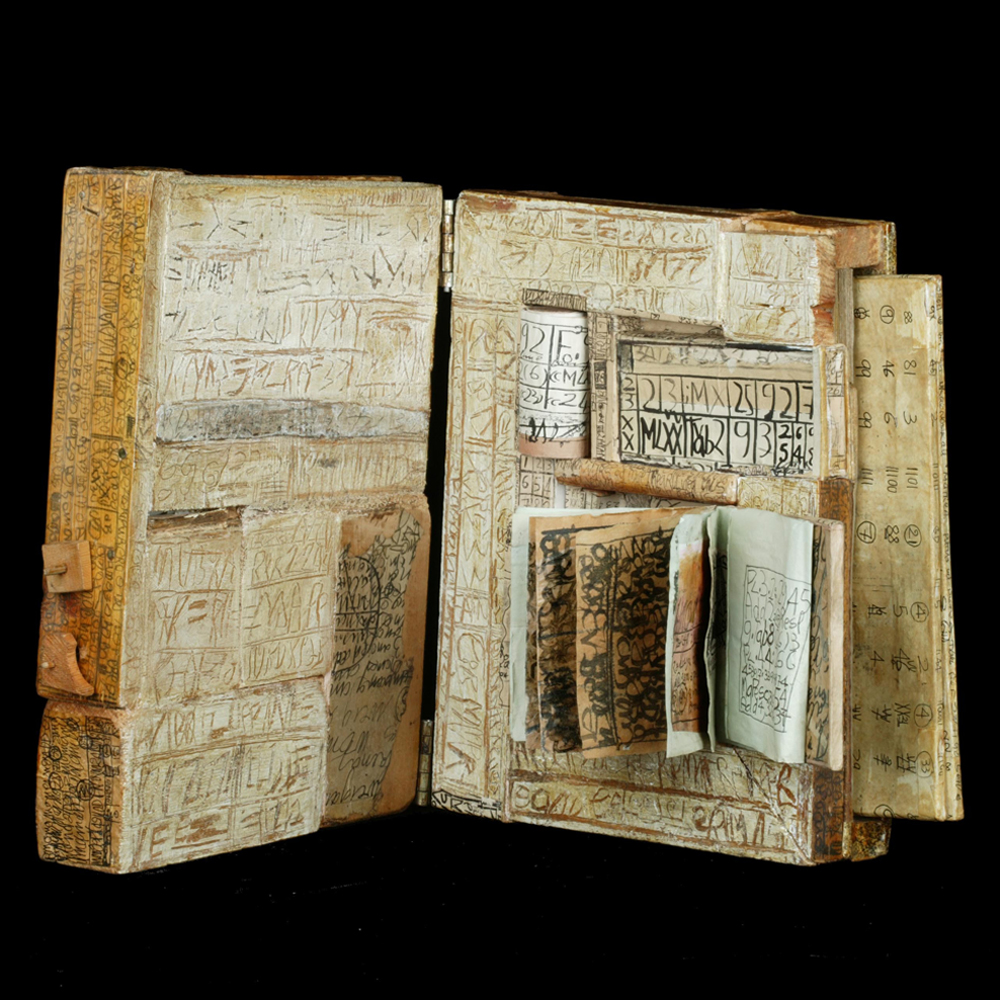
Artists' books are books made or conceived by artists. There are fine artists who make books and book artists who produce work exclusively in that medium, as well as illustrators, typographers, writers, poets, book binders, printers and many others who work collaboratively or alone to produce artists' books. Many artists' books are self-published, or are produced by small presses or by artists' groups or collectives, usually in limited editions.
Artists' books that maintain the traditional structure of a book are often known as book art or bookworks, while those that reference the shape of a book are known as book objects. Other types of work produced by artists in book format include concrete poetry, where meaning is derived from the spatial, pictorial and typographic characteristics of the work, as well as from the sense of the words.
Contemporary artists' books are noteworthy for their many different forms and perhaps because of this they have an equally large number of precursors and influences. Artists have been associated with the written word since illuminated manuscripts were developed in the medieval period. Many have been concerned with books as an artistic enterprise, notably William Blake at the end of the 18th century and William Morris at the Kelmscott Press from the 1890s. Avant-garde artists throughout the 20th century also produced many books as part of their artistic endeavours.
It is however the livre d'artiste, also known as the livre de peintre, that is generally considered to be a key precursor to the contemporary artists' book. Originating in France around the turn of the 20th century, the livre d'artisteis a form of illustrated book. They are distinguished by the fact that the pages have been printed directly from a source created by the artist themselves rather than from a source that has been created by a technician from the artist's design. An early exponent of the livre d'artiste was the dealer Ambroise Vollard who commissioned Pierre Bonnard to illustrate with lithographs a collection of poems by Paul Verlaine, Parallèlement, published in Paris in 1900 (NAL pressmark: Safe 1.A.1). The works produced were essentially deluxe, limited editions, produced on high quality paper using specialised printmakers. They were generally left unbound so that they could be dismantled for display and so that bespoke bindings could be commissioned if desired. Vollard produced numerous works in association with a number of artists, matching them up with texts to illustrate. Various other publishers followed suit, collaborating with artists of their own association. The National Art Library holds a number of livres d'artisteswhich are described in the exhibition catalogue: From Manet to Hockney: modern artists' illustrated books, edited by Carol Hogben and Rowan Watson, London: Victoria and Albert Museum, 1985 (NAL pressmark: CTR REF).
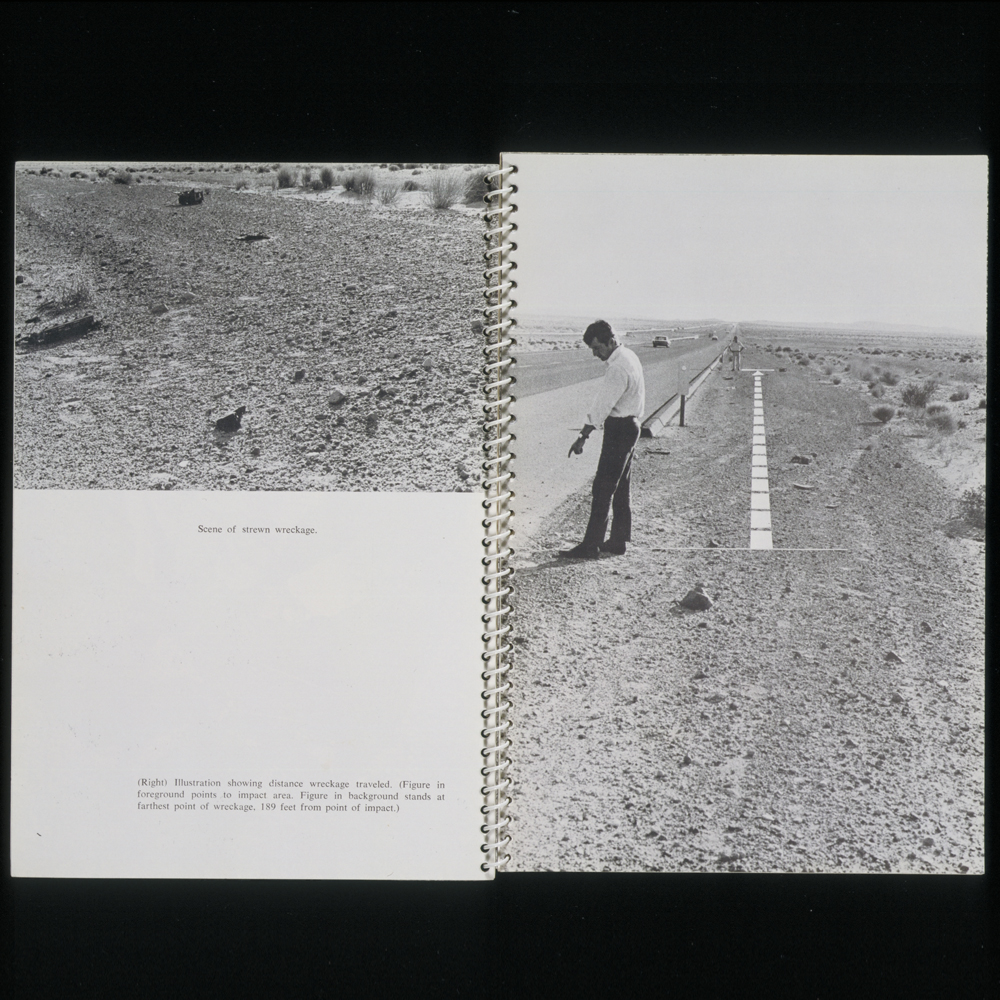
'Royal Road Test', artists' book by Edward Ruscha, Patrick Blackwell and Mason Williams, Los Angeles, California, USA, 1967. Pressmark SC.99.0036
In the 1950s and 1960s Swiss-German artist Dieter Roth (1930–98) and American artist Ed Ruscha (1937–) created conceptual works which are considered the foundation of the artists' book genre. In 1962 Ruscha published the first edition of Twenty-six gasoline stations (NAL pressmark: SA.91.0042) which comprised 26 deadpan photographs of gasoline stations along Route 66 from Los Angeles to Oklahoma City. The book was not intended as a means for the reproduction of pre-existing photographs, but rather as an artwork in its own right. As the piece retains the essential characteristics of a book, such as the idea of seriality and sequence provided by the turning of pages, it is considered central to the development of the genre. Ruscha produced a series of bookworks in a similar vein. Another characteristic of this series was that they were published in unlimited editions, had a wide distribution and were inexpensive to buy, in a deliberate attempt to bring art to a wider audience.
Roth's distinctive contribution to the genre was his examination, through his bookworks, of the formal qualities of books themselves. These formal qualities, such as flat pages bound into fixed sequences, were deconstructed and investigated, this investigation becoming the subject matter of the book itself. For example 2 Bilderbücher (1957) (NAL pressmark: X920000) consists of two picture books of geometric shapes with die-cut holes cut into each page to allow glimpses of patterns from the pages beneath. Subsequent works such as Daily Mirror (1961) involved the use of found materials manipulated to a particular purpose, a technique that was much used by later book artists.
'Little Tentative Recipe', artists' book by Dieter Roth, published by Watford School of Art, England, UK, about 1969. Pressmark 95.S.43
Artists' books became popular throughout the 1960s and early 1970s and the genre has continued to expand. During the 1980s and 1990s many more artists began to use the book as a medium for self-expression and they continue to do so. Techniques remain varied and range from the traditional to the experimental. Small presses and individuals have continued to promote the art of letterpress printing and the hand-crafted book. Some artists have chosen to use computer-generated images while others have used the photocopier to reproduce their work. Many artists have taken up the challenge to experiment with the content and physical structure of the traditional book form. Bookworks and book objects have continued to step outside conventional boundaries to encompass concepts associated with the fine arts. Works range from the minuscule to the gargantuan. Bookworks are not restricted to the use of paper and ink but can incorporate all kinds of materials and appended objects. While such works are usually unique or limited editions, some are produced in multiple copies.

Artists' books in the Victoria & Albert Museum

'Filmboekje', artists' book by Beppe Kessler, Amsterdam, Netherlands, about 1987. Pressmark: X890073
The National Art Library holds the largest collection of artists' books in the UK. The collection is international in scope and is particularly strong in examples from the British Isles and the United States. The Library also has significant holdings from other western European countries, as well as some examples from Russia, Australia, Latin America, Japan and a number of other countries. The collection includes both multiples and unique works. New acquisitions of works are made on a highly selective basis.
Supporting material
The Library has an extensive collection of contextual material, known as the Artists' Book Reference Collection, for research into artists' books. The Artists' Books Reference Collection can be browsed on the NAL Catalogue by choosing the NAL pressmark search from the drop-down list and searching under the pressmark AB. The second element of the pressmark indicates the year a particular work was published, e.g. AB.88.0010 indicates a work in the Artists' Books Reference Collection published in 1988. Information files, many of which contain ephemeral documentation about individual book artists and their books and presses, are also available for consultation.
Catalogues
Artists' books are all listed on the NAL catalogue. Known items may be found by searching under the artist's name or the title of the book. Items can also be found by selecting a Genre or Publication Format Keyword search from the dropdown list and entering the appropriate search term e.g. artists books, book objects, pop-up books, etc.
Access to Artists' Books
Access to the Library is by reader's ticket. For more information see, Registering to use the National Art Library. Due to the fragile nature of much of the material, readers are encouraged to be selective in choosing the items they wish to see. A maximum of six items may be seen in any one day without an appointment.
Group visits can also be arranged to look at artists' books in the Library's collections.
The V&A is committed to respecting the intellectual property rights of others. We have therefore made all reasonable efforts to ensure that the reproduction of content on these pages is done with the full consent of copyright owners and that all credits are correct. We apologise for any inadvertent omissions. If for some reason a credit has been omitted, or there are queries in this respect, please email webmaster@vam.ac.uk

| a multiplicação da cor de um mineral quando este é riscado |


Sobre um traço negro - livro de artista, de Daniel Moreira

O livro inclui textos de Alexandra Balona, Amora Silvestre, Bárbara Fonte, Cristina de OAlves, Marlene Jabouille e Rita Roque. Edição especial e limitada de 30 exemplares.
As capas são em madeira, o interior é impresso em jacto de tinta sobre papel de alta qualidade de 90g.
20 x 15 cm


escrever[te] assim sem mais nada

do silêncio das metáforas anónimas

como dos poemas sem comparações e comparando tudo
paisagens, seres, solidão
_______ falta[me] a palavra começo
| das raízes que crescem do dantian aos olhos |
uma linha a descrever o sentido dos sonhos
no palácio de terra
na cor fluvial dos dias de primavera
coloquei a mão invisível onde crescem as folhas 
| castanhas, verdes e largas |
a espera de ver os pássaros e de ouvir as gotas de chuva
fica para amanhã
(des)cansa em mim a madrugada
há sempre essa teoria
a de abraçar
| as árvores, os campos e as flores |
e depois
os princípios do singular feminino de uma letra vogal

___________ a tentar

___________ a saudade

da palavra plural masculina sem género

amor

_______ falta a palavra fim

[aqui e agora]

Secalharidade/O Encontro É uma Ferida (edição especial)

- Produção de uma edição especial e limitada (30 exemplares) da publicação do projecto "Secalharidade" de João Fiadeiro e Fernanda Eugénio com serigrafia (Atelier Mike Goes West) e livros impressos em Riso (design: Marco Balesteros).
para saber mais: ghost (publicações)

https://www.facebook.com/ghost.publisher

Encyclophilia 4 by Matthew C. Lange

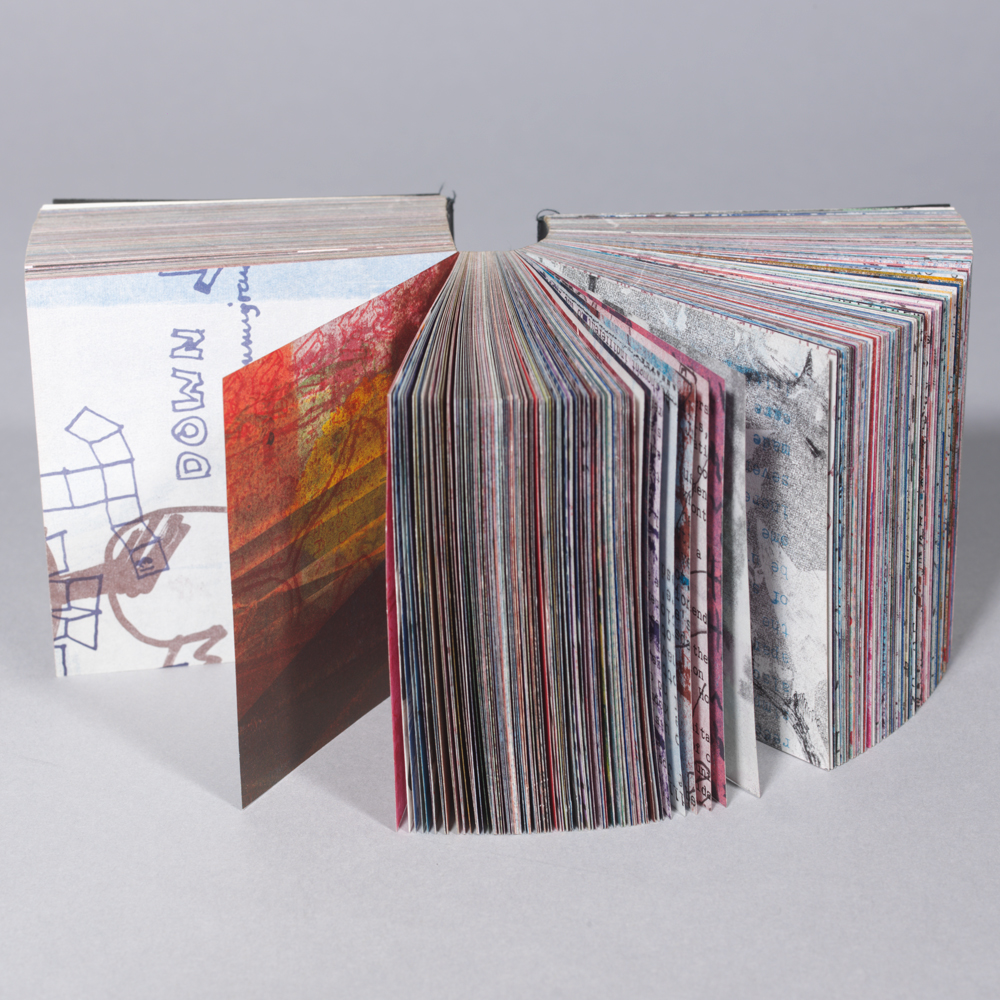
Encyclophilia 4 is an editioned set of “mono-books” that transposes a social theory referred to as The Plummet Machine over important events in American history. Each set in the edition consists of seven 3.5” x 5”, 16 page booklets that have been overprinted on two page spreads extracted from 1960’s era illustrated history books. Matthew will give a presentation tonight at Printed Matter, 6PM: A live demonstration of techniques for deconstructing and reconfiguring systems of knowledge and power, incorporating examples of the various media devices through which we historically consume information - slide projectors, flip charts, and encyclopedia sets - to question the rationality of contemporary classification modes. 

More details:https://www.facebook.com/events/474502709299110/


Livro da Luz


António Poppe (1968, Lisboa) tem uma filha chamada Luz, de cinco anos. Fez a sua formação no Ar.Co. (Centro de Arte & Comunicação Visual) o que permitiu realizar intercâmbios com o Royal College of Art, em Londres, e com a School of the Art Institute of Chicago, tendo obtido um Mestrado em Arte Performativa e Cinema, nesta última escola. Presentemente, participa em recitais de poesia e ensina desenho e meditação.

A Assírio & Alvim publicou o seu livro de poemas Torre de Juan Abad em 2000, e a Documenta publica agora Livro da Luz, poema-meditação-desenho-canção. O livro apresenta o manuscrito do poema, as imagens e desenhos de três cantos e doze canções, assim como um CD com os poemas ditos por si em conversa musical com Ibu Galissá (kora), Bruno Sangareau (guitarra portuguesa) e Nuno Estevens (guitarra clássica).

retirado do blogue: http://blogue-documenta.blogspot.pt/

Nós Somos Quem Somos

em Novembro de 2009 saía o caderno artístico "nós somos quem sois" ilustrado com bonitas imagens da Hélia Aluai e palavras minhas a sua criação partiu do convite para uma exposição da Hélia, com interação performativa da Vera Santos, música de Quico Serrano e, mais tarde um vídeo da Tânia Duarte contava assim o seu começo ----------- Adensar a inspiração e a expiração do gesto artístico. Respirar fundo, profundo, fundir. Fazer das minhas palavras um movimento outro mas parceiro dos outros movimentos que aqui se geraram, desenho, dança, dizer. Fados de dor, dedos esgrimistas em tanto dar. Parei, pensei, avancei, nem sempre por esta ordem, nem sempre com ordem. Um texto é um articulado e uma expressão, pede comunicação, empatia e compreensão. Mas sejamos gente de esperança e que resulte dela, mais do que tudo, a sua emoção. As palavras são ritmos, sobre fios, equilibristas. As palavras são costume, ferramenta, serviços prestados. Eu não desenho imagens das palavras mas uso imagens para desenhar palavras, não canto as palavras mas sonho acordada em claves de sol. Eu sou mulher, nós somos três, trio, cúmplices, inconsciente, colectivo. Nós somos mais, perdi a conta, sem vezes, demasiadas. Nós somos quem sois. Nós somos quem sois. Nós estamos em tudo. A lida, as horas, o passado, o presente, o futuro, do tempo que voa. Nós somos senhora e gaiata. Visão de dentro, sentida, sem ofensa, distante, do mesmo e de outro planeta. Nós somos de Vénus, corpos a tocar as estrelas, de mantos negros cobertas. Nós somos elas. Eu sei que vocês sabem. Que vocês são movimento também, gesto indefinido, escrita de quem lê, enquanto seguram na folha, os vossos pensamentos agitam-se, os seus olhos balançam, da esquerda para a direita, de cima para baixo, por vezes, avançando, recomeçando. Eu sei que vocês reconhecem. Que vocês são interrogação, exclamação e reticências. E que é difícil voltar à página do início depois do ponto final. Sabem que por dentro, das palavras, muitas histórias se calam. Estamos de novo no começo. Insolente, orgulhoso, desconcertante, em luto, em luta, em abandono, a mando, a sumir, em esperança, à espera, fugidia, vadia, marcante, marcada, sumida, presente, dignificante. Elas são figuras de espanto suspenso. Elas mostram ecrãs de séculos passados. Elas… Em visões simbólicas, a mãe que conta a história à filha que a sua avó já contava, retalhos, migalhas de uma manta pintada em diferentes cores mas que no final serão sempre a preto e branco. Elas, como as palavras escritas numa folha de papel, mesmo que tingidas de sonhos a purpurina colorida, umas em realce, outras bem gastas, tinta negra em fios que mancham, sonhos de papel reciclado, contos amarrotados que se continuam a reescrever, sem conta. Elas somos nós. Nós somos a que cala o que diz, a que queda o que escorre, a que envolve o que fica, a que agradece o que se esforça, a que lê o fim para aplaudir ao princípio. Nós… Num palco, matéria de realização do espectáculo a que assistimos de pé para no final varrermos a sala e fecharmos a luz. Holofotes, magia, acção. Vidas reais pelas mãos traçadas, de palmas batidas, escondidas, uma a uma. Nós, num conjunto, soltos, seres individuais, e do amargo de tantas lembranças deixamos, sem querer, de abraçar, até sermos apanhados de surpresa num abraço subtil, num manto negro colhidos na ironia do destino, desse fado, de olhos fechados. Nós somos elas. Neste traço, neste salto, nesta escrita, feitos de movimentos e de gestos, de alma e de corpo. Tudo isto é fado, tudo isto é vida. ------------- o texto do caderno fica por revelar, se quiser adquirir um escreva um email ao meu cuidado (madamezine@gmail.com)
NÓS SOMOS QUEM SOIS (WE ARE WHAT YOU ARE) from Tânia Duarte on Vimeo.